AISC Modern Steel Construction: Accessible Automation
This article was originally published in the April 2026 issue of Modern Steel Construction. Visit: https://lsc-pagepro.mydigitalpublication.com/publication/?i=861568&p=54&view=issueViewer
Steel fabricators are constantly seeking ways to meet growing production demands with a stagnant labor supply. Most have multiple approaches to bridging that gap, and one in-shop method centers around increasing an individual’s productivity—often with automated and robotic fabrication tools that have helped modernize structural steel fabrication processes across the nation.
The idea is to provide tools that empower one human fabricator to produce a significantly larger output than they could with only manual methods. One popular automation tool in fabrication shops is the collaborative robot, or cobot, which is an industrial-grade robot equipped with force and torque sensors that enable it to work safely alongside human operators.
Cobots offer greater flexibility, a smaller footprint, and lower deployment costs than traditional industrial robots, which are often caged for safety. Unlike traditional industrial robots, a cobot can be taught by operators on the shop floor with little to no automation experience. Operators guide the cobot along the desired weld path by hand, teaching waypoints as they go (point-and-shoot programming). The ease of programming makes cobots more accessible to shops without specialized automation teams, while still offering feature-rich, capable software. Getting cobots into production does not require months of custom engineering and facility design. Instead, they can be rolled off a pallet, plugged in, and, in some cases, operated that same day.
Bespoke traditional welding robots still have a place in many shops, but the plug-and-play nature of cobot welding tools lowers the barrier to entry into automation from a personnel, capital, and timeline perspective. Easy setup is one reason why cobots have become widely adopted in fabrication shops.
An increasingly popular way to introduce automation is to deploy cobot solutions that function as a multitool rather than a specialized implementation. For example, a fleet of welding cobots can be used to tackle heavy and light fabrication while operating in a familiar software and hardware ecosystem. Rather than focusing on purpose-built solutions for single applications, cobot welding and cutting tools are adaptable across different applications and can be learned quickly by operators of all skill levels.
The heavy fabrication division of one shop in northern Texas found that its parts were too large and rarely repeatable to automate using traditional robotic systems without incurring excessive cost and complexity. Purpose-built traditional robot welding systems would likely take months to reach production readiness due to custom engineering, facility modifications, and installation. Some projects with minimal part mix and large batch sizes can justify a purpose-built robot welding system, but this shop needed a flexible solution that could be deployed to different applications. Many fabricators are in a similar position—needing to modernize with welding automation but not wanting to take on the complexity and capital requirement for a custom-built robotic solution. A growing number are deploying mobile welding cobots that can tackle a variety of applications out of the box.
The shop first adopted a cobot-to-workpiece strategy for welding long multipass seams. Operators position the cobot adjacent to the workpiece, teach the cobot their desired weld path by hand, and then sit back to watch the cobot strike an arc while they turn their attention to other work in the shop. The cobot completes 20-ft welds in 30 to 45 minutes instead of the eight hours needed to weld these sections manually.
On most days, the shop uses the mobile cobots semi-autonomously for long continuous weld sections (2F, 1G, 3F, 3G). The process is semi-autonomous: an operator manually teaches the weld path, and the cobot proceeds to weld multiple passes without operator intervention (unless inter-pass cleaning or temperature checks are required). Weld paths do not have to be linear like they would with a track welder, because the cobot’s six-axis design can adapt to almost any taught path. If the demand for welding long seams dries up, the system does not sit idle and can be redeployed for 1G pipe work or repeatable small parts as needed. The cobot can be easily relocated to different areas of the fab shop as demand varies.
Using the cobot for long seams is a raw productivity boost and has some hidden benefits. For example, a welder working with the cobot is more comfortable than a welder hunched over a weld seam for eight hours. The improved positioning also removes the need for welders to be as close to the arc and its associated toxic fumes.
Elsewhere, one Central Texas-based fabrication shop has recently modernized its column-to-baseplate production with cobot-driven complete joint penetration (CJP) welds. The goal was not to reach a 100% robotic, no-human-involvement automated process, which this shop believes would increase complexity and rob their manual welders of important work. Instead, the company uses cobots for the most critical and difficult welds, such as CJP grooves, while manual welders handle finishing tasks like back-gouging, where a human eye ensures consistency and smooth tie-ins.
Multipass CJP weld joints are uniquely tricky to automate, but the Central Texas shop’s success is due in part to its consistent beam cutting and other upstream processes—consistent parts in, consistent parts out. Upstream consistency is often a deciding factor in determining whether a particular fabrication line is ready for welding automation. When consistency is the top priority, it is not uncommon to see more than 30% improvements in weld pass rates per AWS D1.1/D1.1M: Structural Welding Code – Steel nondestructive testing (NDT).
For other shops, the bottleneck is not in their heavy welding, but in high-quantity parts like gusset plates, pile caps, clips, or beam attachments. For example, AISC full member fabricator Kennedy Fabricating near Houston uses the same technology as the other two shops but achieves return on investment by welding thousands of repeatable beam attachments with a cobot rather than one-off heavy welding applications.
Unlike the previous examples, Kennedy Fabricating configures its mobile cobot to weld batches of up to twelve parts at a time in a repeatable fixture. When first setting up the job, more time is dedicated to creating a specialized program that combines some of the cobot’s more advanced features, such as part patterning, touch sensing, and multipass welding, to ensure accurately welded parts.
Once the program is saved, a batch of parts can be welded with one button press. When the operator loads and unloads parts in step with the cobot’s welding cycle, program runtime approaches 100%, which is rarely achievable in manual welding operations.
The high runtime is possible because of the cobot’s built-in safety that allows the operator to work directly alongside the system. Many fabricators establish two dedicated welding zones, where the operator and cobot work simultaneously—one loading and unloading parts while the other welds—eliminating costly idle time. Under typical production conditions, the cobots at Kennedy Fabricating are dedicated to welding thousands of structural beam attachments, but they are ready to be reassigned to new projects if needed.
The success of any cobot welding project also depends on the people and processes that surround it. A strong cobot champion who shows eagerness and ownership of the system makes a massive difference in its effectiveness. Equally important are robust upstream processes, such as consistent fit-up, accurate cutting, and reliable material prep, that enable automation to shine and require skilled workers and keen eyes. Automation isn’t replacing shop floor workers—it’s here to make them more productive and empowered in their work.
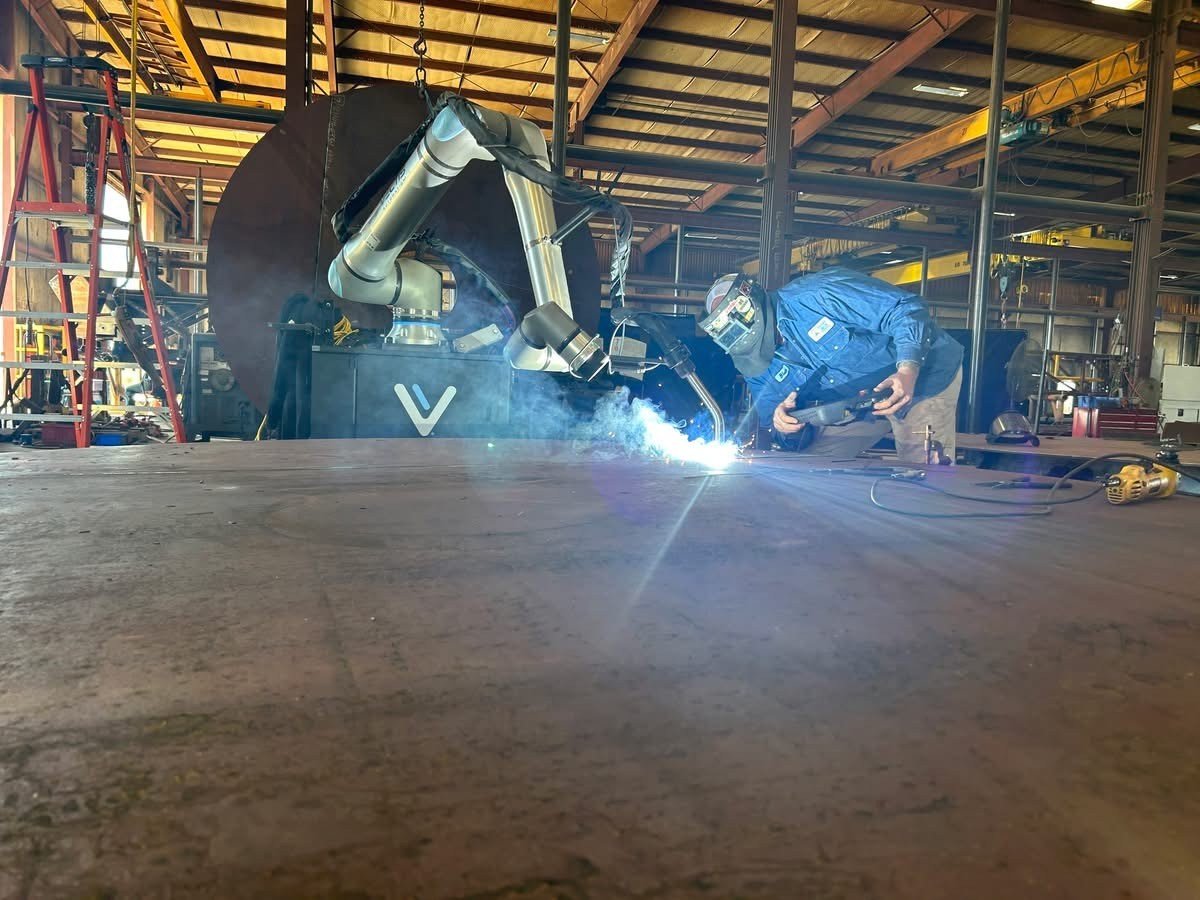
Sharp Iron Manufacturing: Cobots boost productivity but still need a welder’s trained eye.
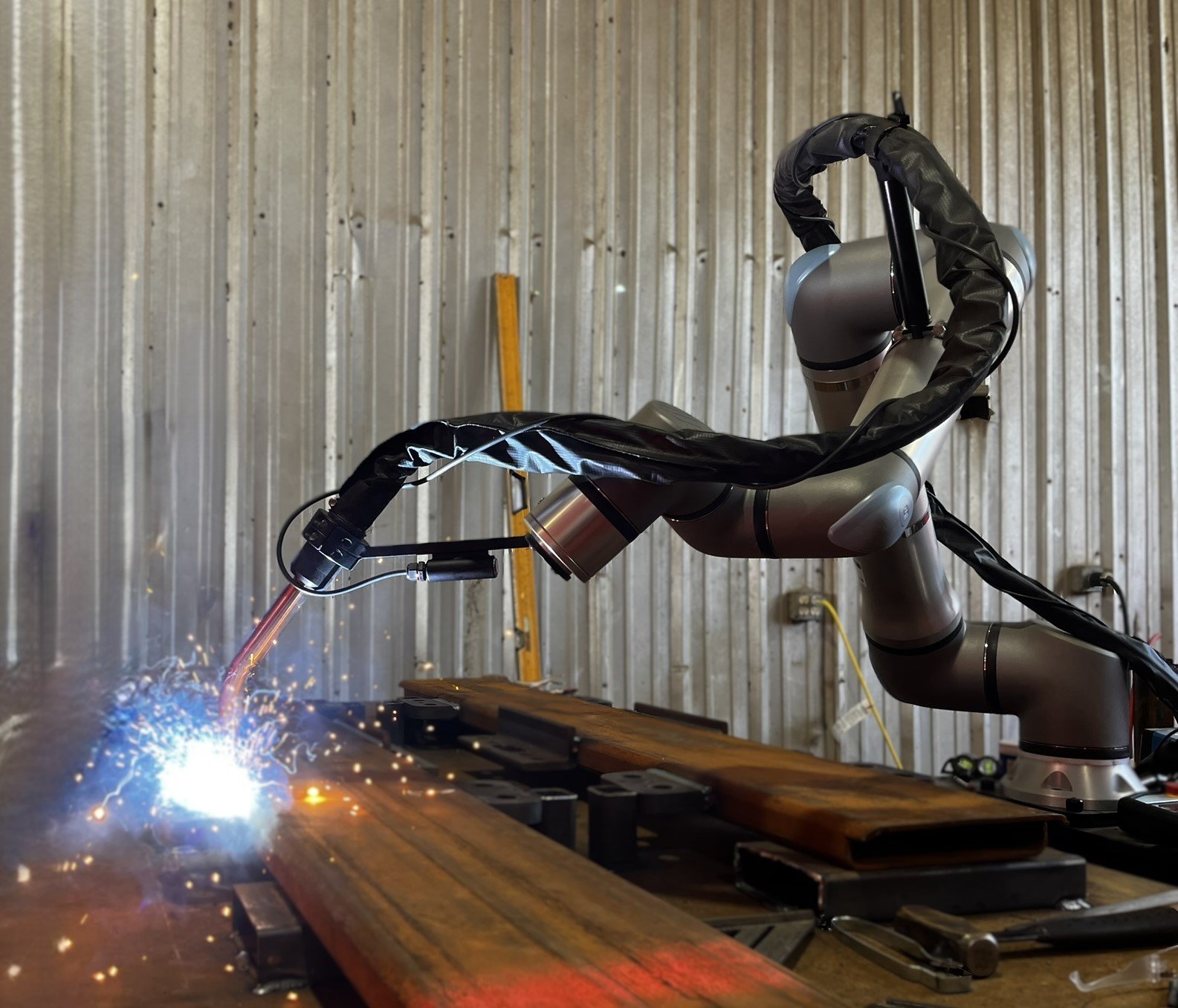
Kennedy Fabricating
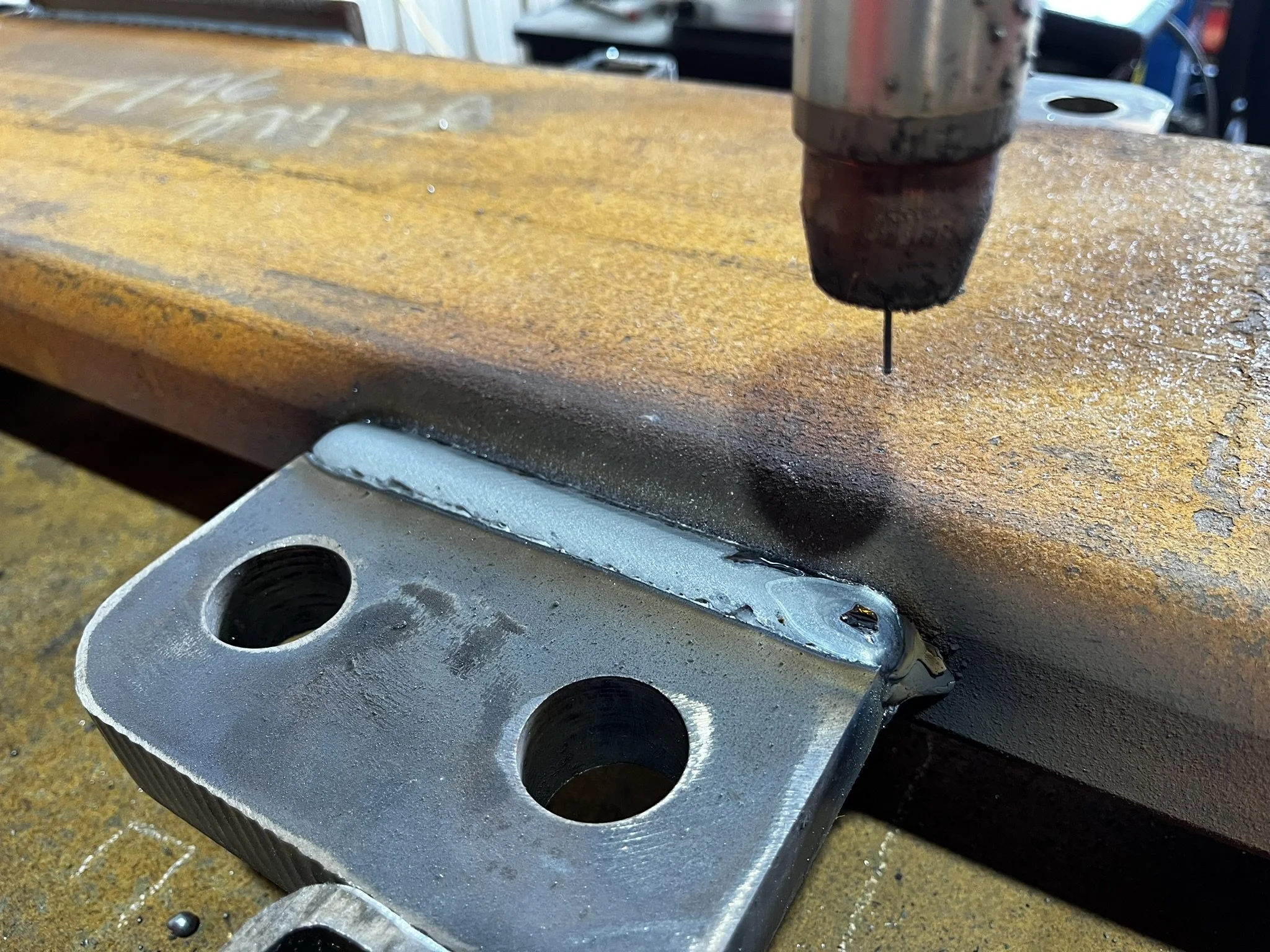
Kennedy Fabricating: Cobots can weld repeatable fixtures in large batches.