AWS Welding Journal: On-Device AI Improves High-Mix Cobot Fabrication
This article was originally published in the November 2025 issue of AWS Welding Journal. Visit: https://www.aws.org/magazines-and-media/welding-journal/2025/november/wj-nov-2025-feature-implementing-ai-in-welding
How embedded AI features and tools are making a difference
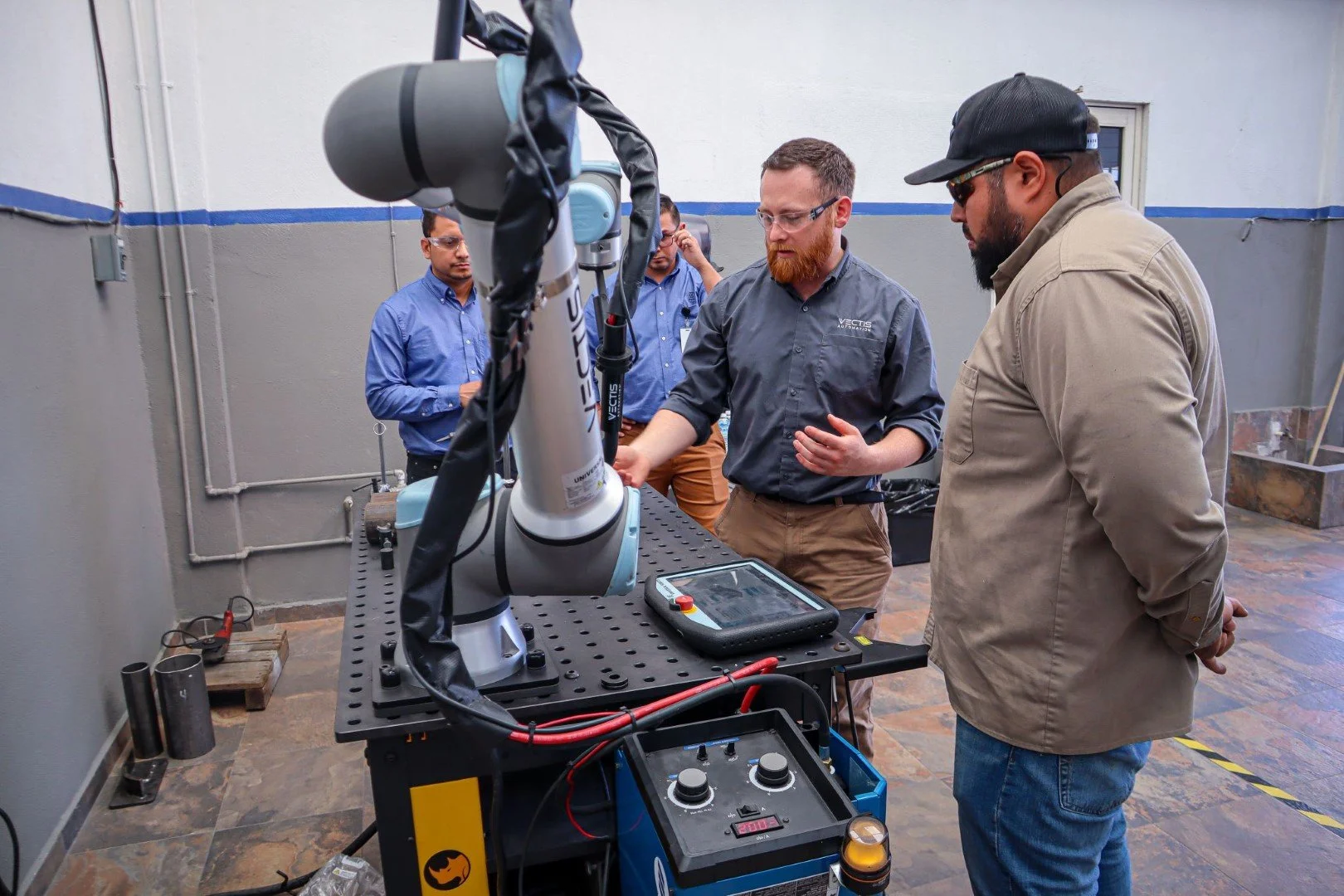
Cobot welding tool training.
Cobot welding systems have evolved to provide fabricators with an ever-increasing range of advanced software features, enabling potential far beyond gas metal arc welding in a straight line. Today, advanced cobot welding features using on-device AI are working to make high-mix cobot fabrication more efficient than ever.
Cobots and the Drive for More Accessible Automation
A primary factor that led industry pioneers to invent collaborative robotic welding was manufacturers’ need for lower-cost, lower-risk automation compared to traditional robotics. While manufacturers have successfully implemented robotic welding for decades, this level of automation presents a cost, footprint, and level of programming knowledge that is out of reach for many small- to medium-sized shops.
Collaborative robotic welding was introduced as a solution to level the playing field and provide accessible automation to shops that were not the right fit for the substantial investment of traditional robotics.
The Introduction of Embedded AI Features
Thousands of cobots have since been successfully implemented in industrial welding applications across North America and beyond. As more manufacturers have introduced cobots into their operations, more advanced software features have been added to these systems, often based on feedback from welders and manufacturers.
For instance, Vectis Automation, Loveland, Colo., implements a range of embedded AI features to help manufacturers achieve high-quality, consistent welds and cuts with a lower barrier to entry. These features work by referencing points trained by the cobot operator, automatically adjusting the travel and work angles to match production standards and auto-detecting corner transitions to allow for optimized welds on complex geometries.
Rather than having to place the torch and manually teach all points precisely, these AI features are in place to perform the calculations for the operator. Further features such as intelligent multipass welding, automatic joint tracking, and smart path generation for plasma cutting are also available to manufacturers.
“We’ve seen these tools assist operators at all skill levels to step in and execute high-quality welds quickly, even when they’re not an expert welder,” said Josh Pawley, vice president of business development and founding partner at Vectis Automation. “This is a huge boon to fabricators, opening up a broader labor pool while still creating qualified welds.”
AI Tools Teaching the Next Generation of Welders
These tools are delivering flexibility and agility to shops that face labor gaps and high turnover.
“It can be difficult for shops to find that welder with years of experience who knows, for example, the best practices of running with a certain work angle and a travel angle for a specific weld,” Pawley said. “AI weld path optimization makes it possible for a new welder to quickly jump in and meet these standards and smooths some of the tribal knowledge barrier that welders naturally gain over the course of a long career. We’ve even seen dozens of times where the knowledge of an experienced welder in the shop is essentially passed on to the next generation via the cobot tool.”
Shops often find that younger workers quickly pick up on this technology and are excited to work alongside it.
“We’ve seen many examples of workers without an extensive background in welding pick up these features and just run with them,” Pawley added. “We’ve seen instances where someone who had been grinding in the shop expressed interest in learning how to use the cobot, and now they’re becoming these AWS-certified welding machine operators, creating welds that meet standards of D1.1 [Structural Welding Code — Steel], D1.5 [Bridge Welding Code], D1.8 [Structural Welding Code — Seismic Supplement], and more.”
Ease for High-Mix Applications and Robustness for High-Volume Applications
Leveraging advanced software tools has helped manufacturers achieve automation success beyond repetitive, fixtured parts.
“High-mix shops are an environment where the collaborative nature of the system really shines,” Pawley continued. “We’re seeing a lot of customers in structural steel, shipbuilding, and other heavy industries have success working with one-off parts and manually programming each weld or plasma cut. We find that after getting comfortable with the cobot, operators are generally programming individual welds in less than 20 seconds with the help of the on-board AI tools.”
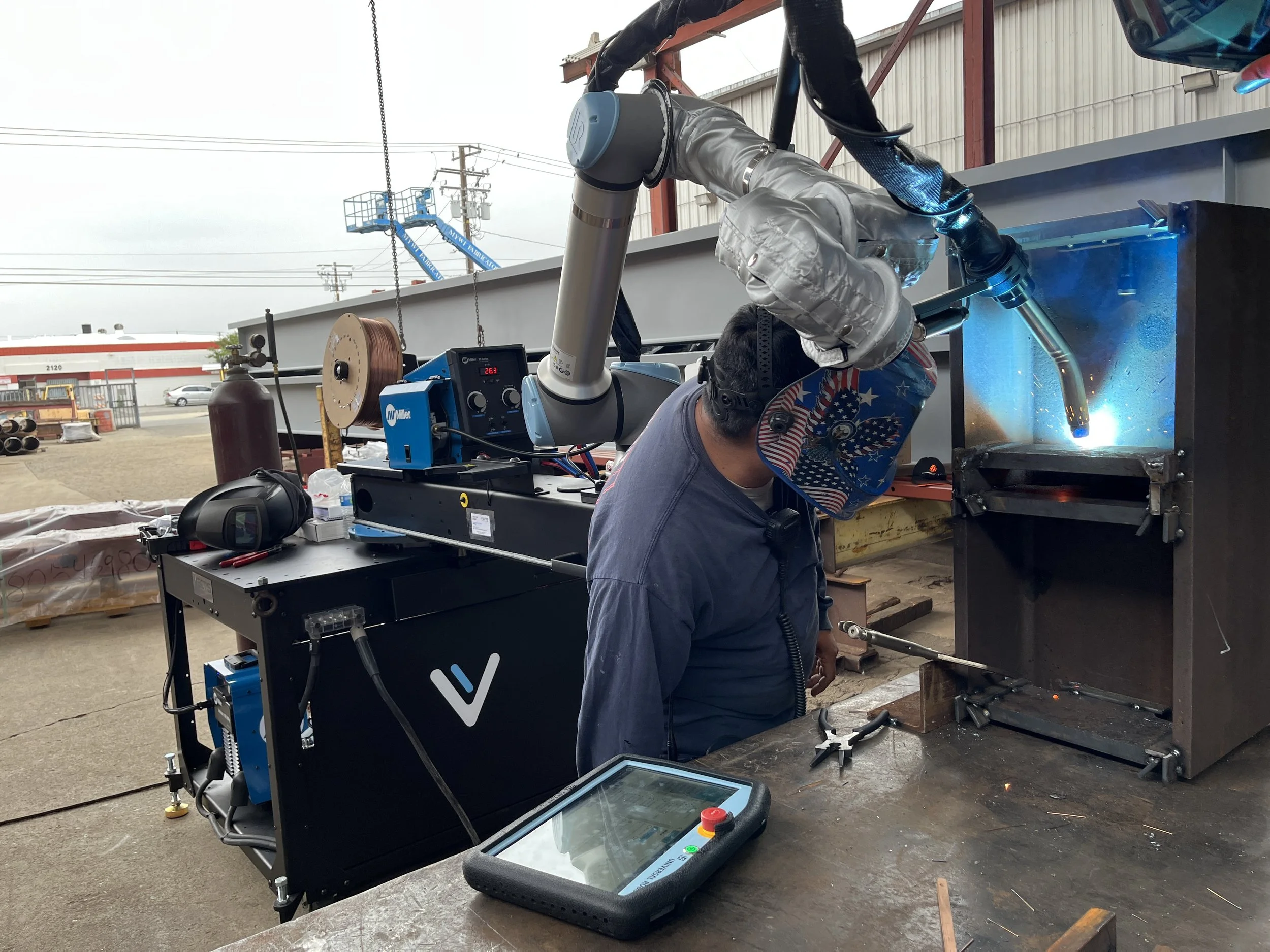
A structural steel fabricator welds with a cobot tool.
Cobots’ significantly lighter footprint and increased portability compared to traditional robots make them a natural fit for shops welding a high mix of parts. Certain deployment methods allow cobots to be brought to the part, taught a weld pattern that is optimized with the help of AI tools, and moved on to the next part, allowing shops to automate well beyond repetitive applications.
Conversely, shops specializing in volume manufacturing also find success utilizing cobot tools. Pawley explained that cobot welding has the potential to thrive in the right low-mix, high-volume environments in much the same way as traditional robotics.
“In our six years and 700-plus cobot tools deployed, we’ve really enjoyed seeing how many types, sizes, and skill levels of fabricators have been able to put these systems to use,” Pawley said. “The application spectrum is huge; we have dozens of customers welding one-offs with the help of AI tools but also customers running high-volume parts who appreciate the simplicity of cobots and the ability to free their welders’ time to focus on more skilled work.”
Pawley said that one customer recently passed their one-millionth weld on a cobot system, indicating that cobots have viable potential for applications once reserved for traditional robotic welding.
Looking Ahead
Zach Bennett, software engineering manager at Vectis Automation, noted the team continues exploring how AI tools can be used in troubleshooting, enabling easier access to training and developing further on-pendant tools to improve weld quality.
“We’re always exploring new tools and technologies to improve the user experience, but we’re also committed to maintaining the simplicity that people love about cobots,” he said. “If a new technology adds complexity without delivering real value to the user on the shop floor, we’re not interested.”
Bennett opined that AI tools are most useful when designed with the fabricator in mind rather than chasing new technology that may be exciting to a software engineer without considering the benefit across a broad range of users.
“New technology should genuinely improve the user experience by simplifying workflows and reducing friction,” he emphasized.
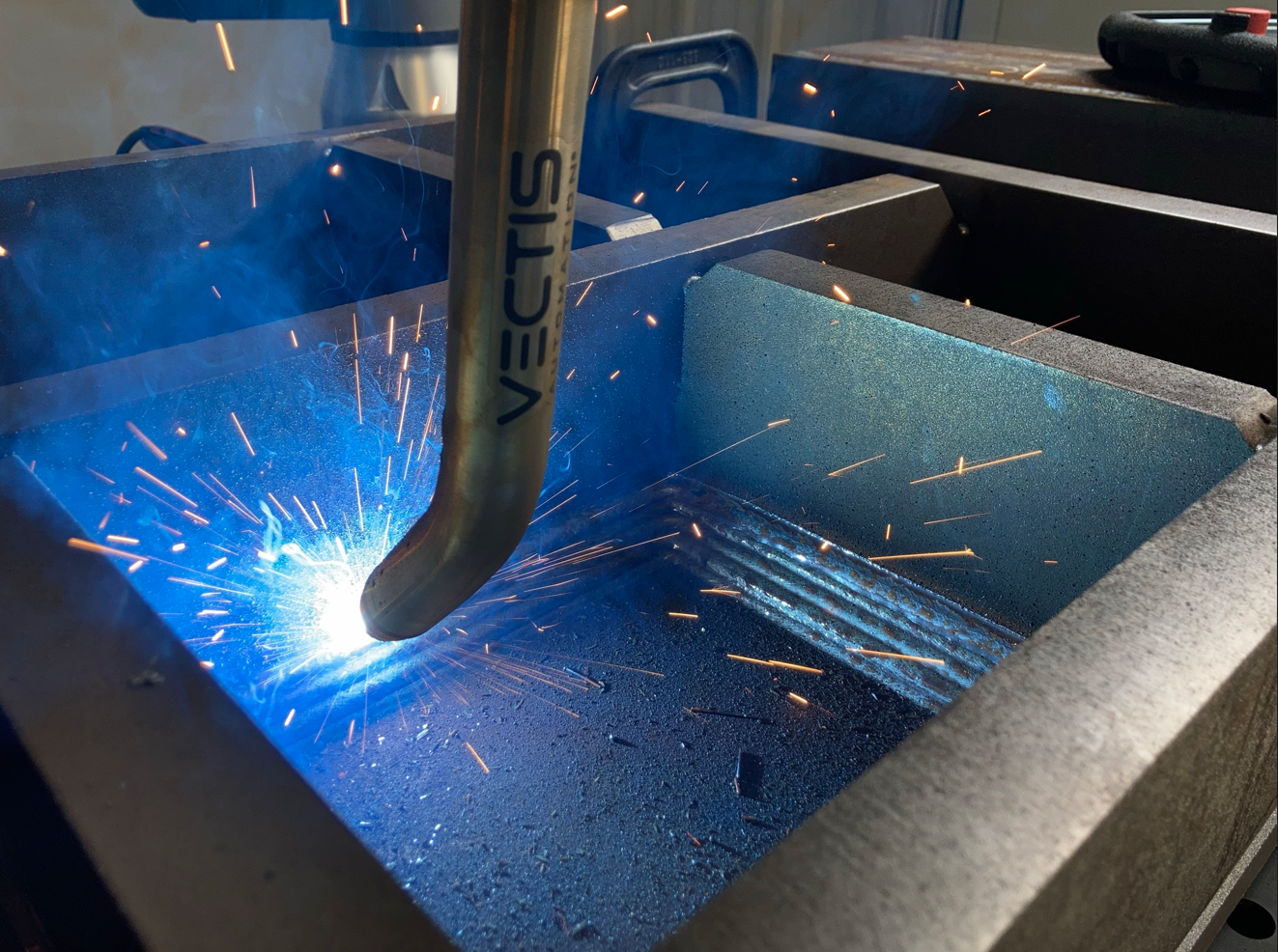
A multipass welding feature on a cobot welding system.
Final Thoughts
The introduction of AI tools into cobot welding is a natural progression of the original human and machine vision of collaborative robotics. These tools are already being successfully implemented in shops that specialize in fabricating one-off parts.
“AI features are almost always most effective when used as a tool alongside human skill and knowledge,” Pawley said. “These are all tools in the toolbelt of a skilled and eager cobot champion, and they’re ultimately going to help folks learn faster and create better welds with greater ease, empowering manufacturers along the way.”