Leveraging Vectis Tools for High-Mix, Custom Fabrication
KYJO Steel | Woodstock, Ontario
At a Glance
MANUFACTURER TYPE

Custom Heavy Structural Fabrication
CHALLENGE

High-mix, low-volume production and limited capacity made it difficult to take on larger jobs, while skilled welders were tied up performing repetitive welding tasks
VECTIS APPROACH
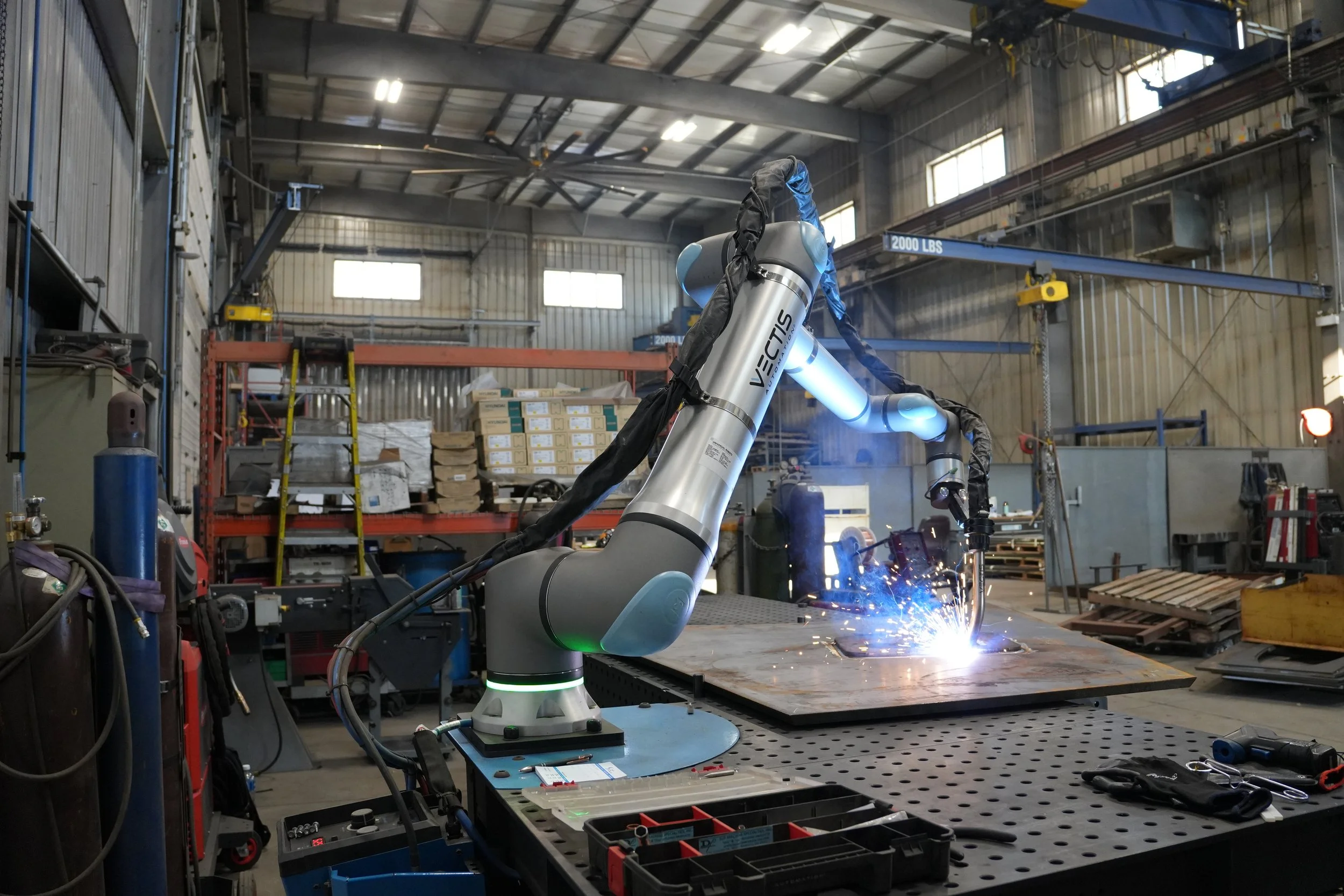
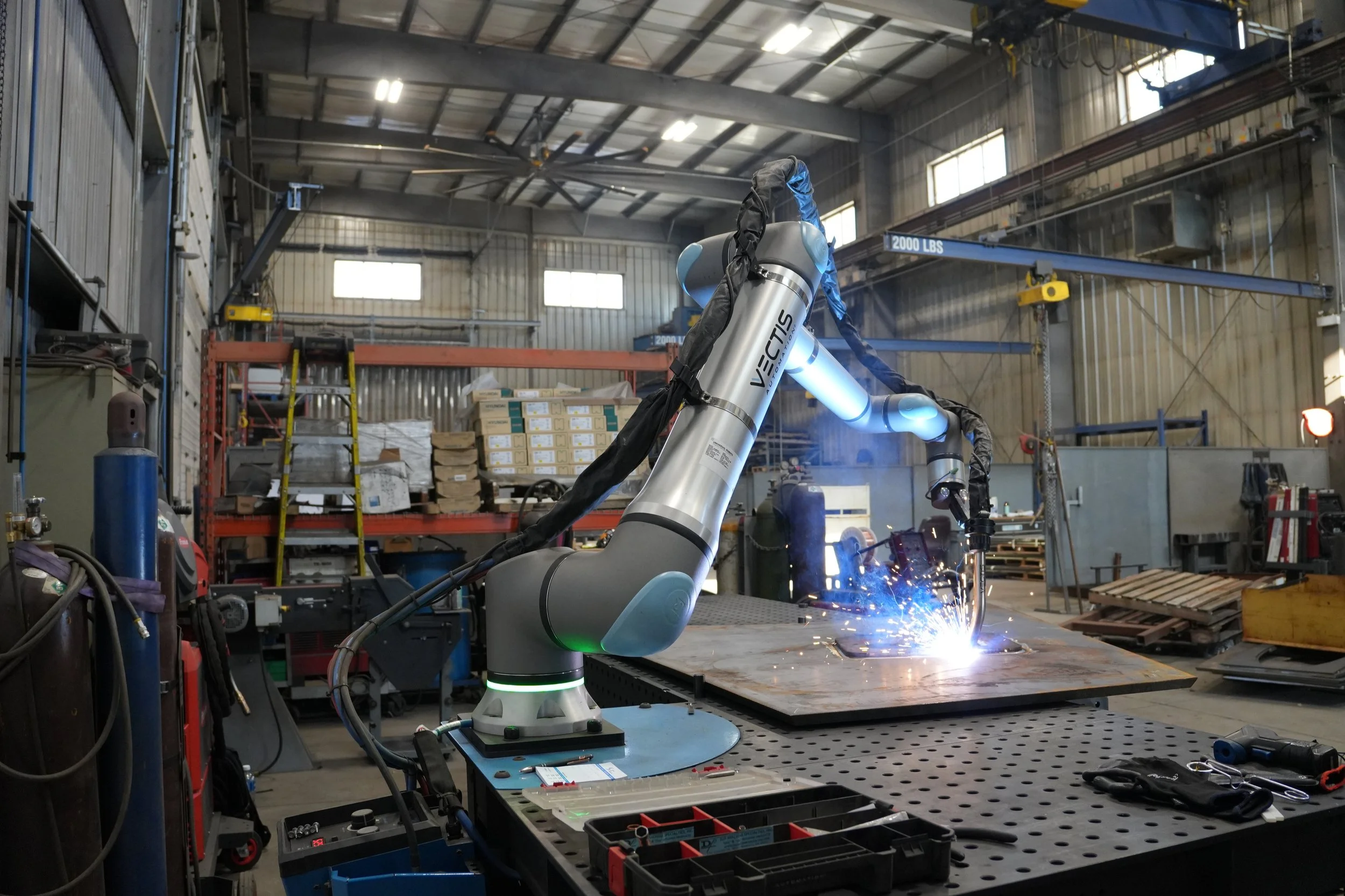
Deployed a Vectis XL Grid Cart (UR20 cobot arm) to automate repetitive welds with flexible programming, supporting both small production runs and larger fabrication jobs
OUTCOME

• Reduced weld time by 2–3x on key applications
• Automated small production runs of 5–10 parts
• Increased capacity to take on larger and more complex jobs
• Improved weld consistency and eliminated start-stop defects on complex welds
WHY IT MATTERS

Expanded capacity and flexibility in a high-mix fabrication environment, improved weld consistency, and freed up skilled welders to focus on higher-value fabrication work
Introduction
As a full-service custom metal fabrication shop, KYJO Steel’s work spans structural rolling, plate rolling, welding, forming, blasting, and more. Their customers rely on them for custom projects of all types, often on tight timelines. That flexibility is a competitive advantage, but it also created a constant balancing act.
“A lot of our projects are, a customer calls and they have a job,” explains Luke Bender, Operations Manager at KYJO Steel. “And now they’re four weeks out, and realize they’re not going to get it done, and they need help.”
Before adding a cobot to their team, “if [KYJO’s welders were] busy for the next two weeks, I can’t even look at the job.”
As a small shop with a team of nine full-time welders, KYJO found themselves with limited ability to take on larger production runs or take on certain jobs in urgent situations. So, KYJO turned to a Vectis cobot welder as a way to expand capacity without overextending their team.
“With the ease of programming [the Vectis cobot]…
doing small runs of 5 to 10 pieces is not a problem.”
Kent Johnston (Owner, KYJO Steel)
The Challenge
As a high-mix, low-volume custom fab shop, KYJO Steel typically runs small batches, with anything over 50 parts considered a large order.
“Sometimes, customers want us to look at larger production parts, and before we weren’t able to do that. We kind of shied away from doing larger batch parts,” Luke explains.
At the same time, certain repetitive projects were consuming valuable time of their skilled welders. In one case, an increasing project required the full time of two experienced welders to keep up with demand.
KYJO recognized that if they could free up their welder’s time from these repetitive welds, they could prioritize higher-value work and take on more jobs overall.
A discovery at FABTECH®
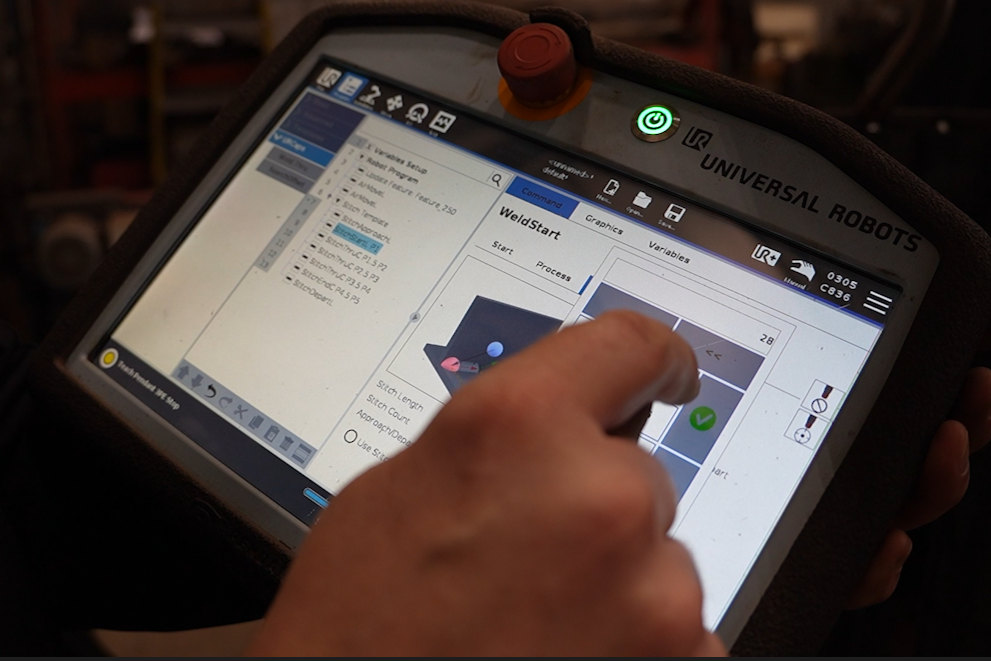
After speaking with several cobot integrators and demoing systems in person at FABTECH® Canada 2024, the difference for KYJO was clear. Luke stated that after looking at the some of the other systems available, “it seemed like they were 2 or 3 steps behind” the capabilities offered by Vectis software.
The ability to get hands-on with a system showcased the programming depth and ease-of-use, but as Luke explains, his interactions with the Vectis team were what made the decision easy.
“Some of [the other integrators] didn’t really have the technical or the trade side of it.”
“But when I went to the Vectis booth, they weren’t afraid to just go over to the machine and do it right then and there, right in front of you … that’s what drew me in.”
After purchasing a system, setup proved to be a breeze for KYJO. “You take it out of the box, you bolt the things together, you put the welder to it, you put the power to it, and you are running,” says Kent Johnston, Owner of KYJO Steel.
High-mix flexibility and increased capacity
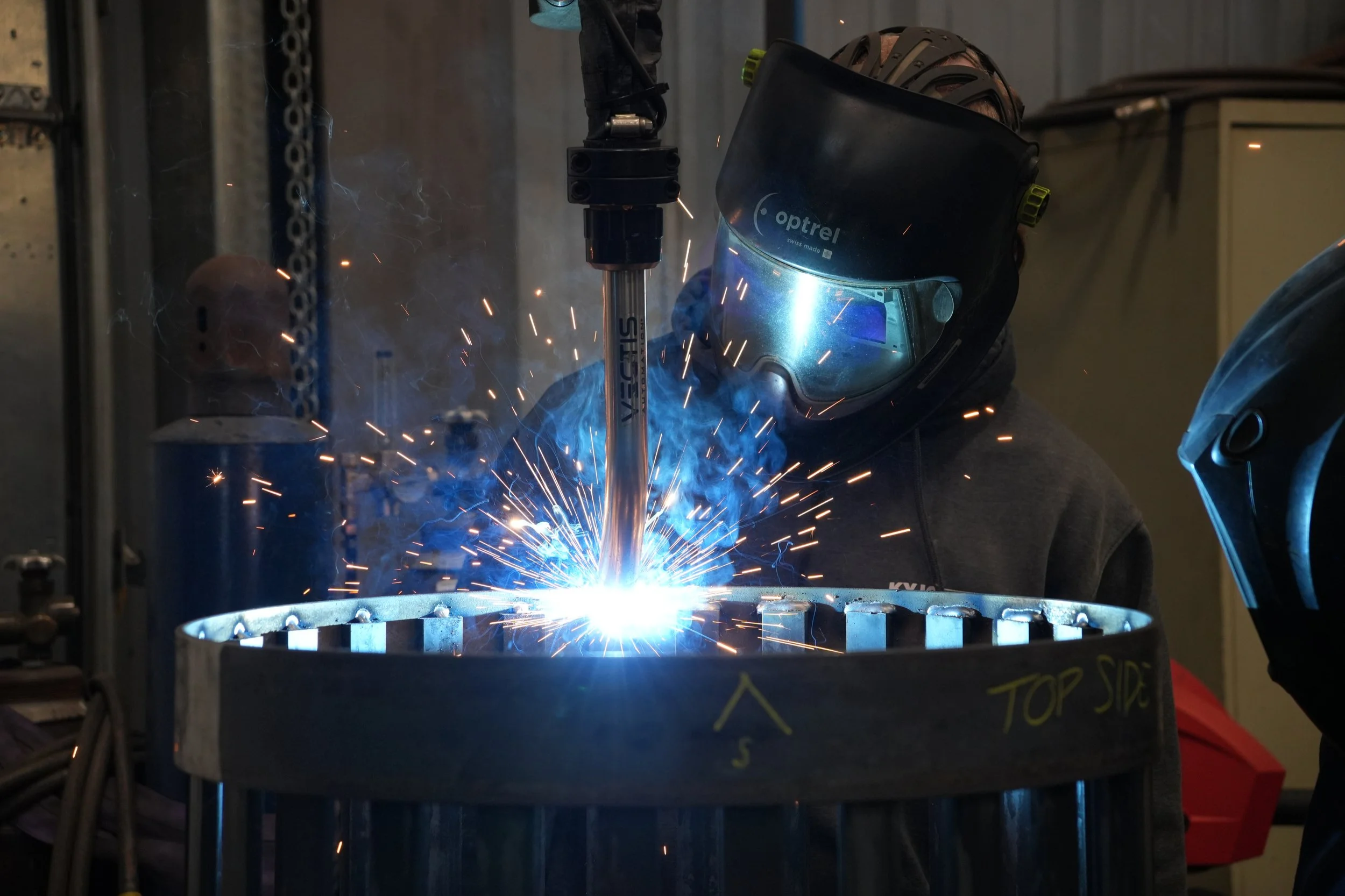
On some common weldments, KYJO saw welding time reduced by 2-3 times. The cobot has also given them the flexibility to take on work they previously had to turn down.
“Now I can look at certain parts of a job and say, I could bang out 300 of these, no problem,” stated Luke.
The ease of programming the cobot has proved equally valuable on small runs, which make up the majority of KYJO’s work as a high-mix, custom fab shop.
“With the ease of programming … you pick your start point, you pick your end point, you pick your weld size … doing small runs of 5 or 10 pieces is not a problem,” says Kent.
Increased throughput at higher quality
Beyond expanding their capacity, KYJO achieved higher weld quality and consistency.
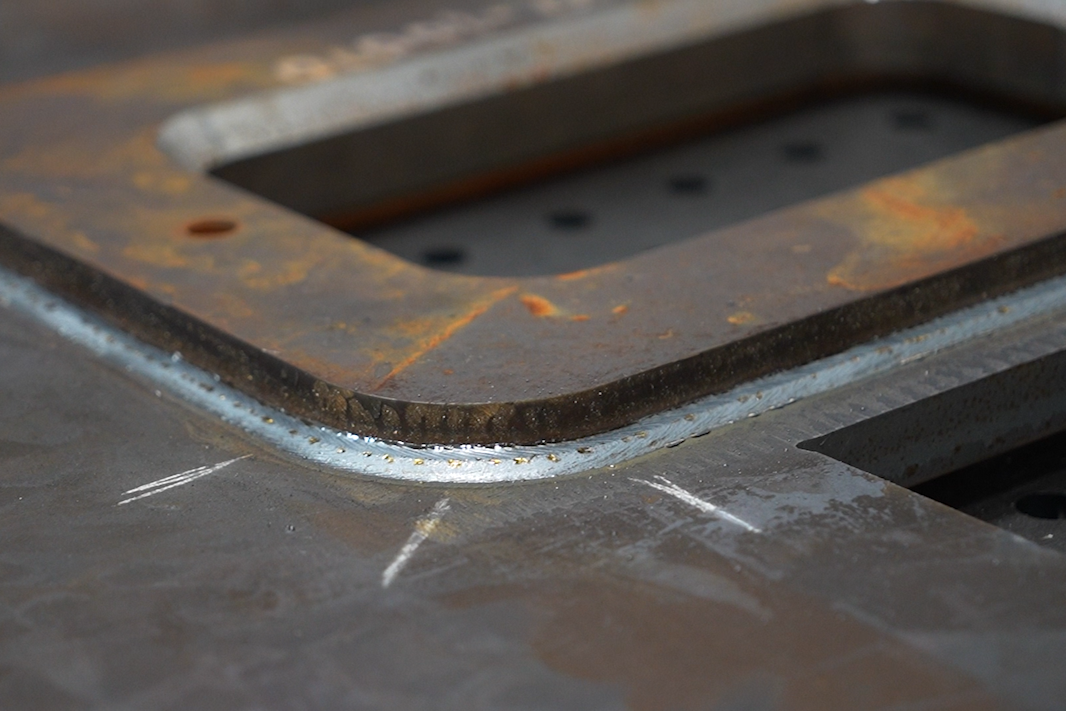
“The repeatability is amazing on the cobot. Once you’ve created a program and have the parts set, you get the same weld every time,” remarked Kent.
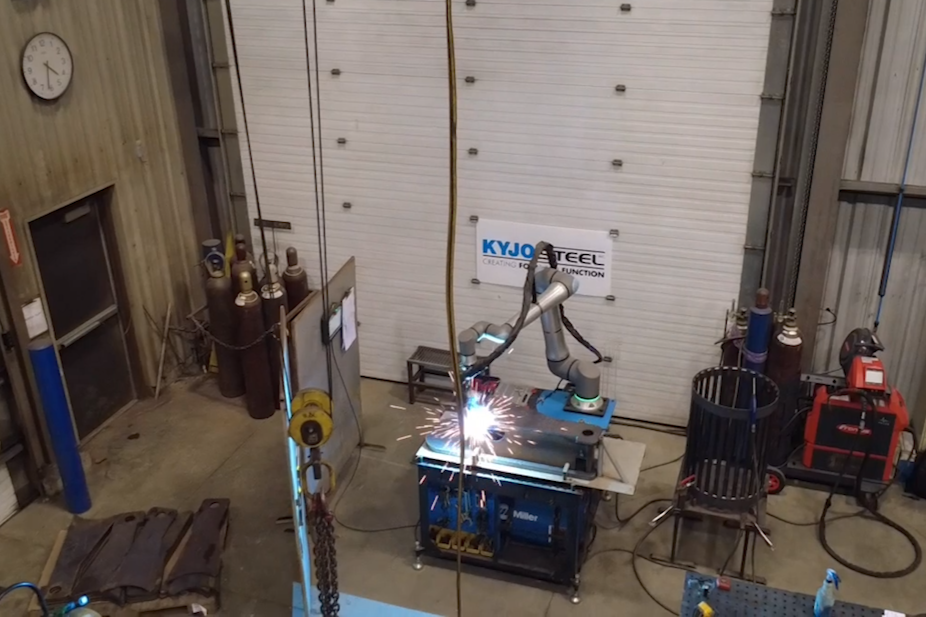
That consistency showed up clearly in some of KYJO’s complex custom projects. On a stainless steel dish head requiring a multipass weld, the cobot completed all eight passes in one continuous operation.
“Perfect weld. No stop-starts.”
By comparison, manual welding would require multiple stops per pass, requiring additional grinding and cleanup.
The same advantages applied to circular welds around small pipes, and welds in tight access areas, both of which are common in KYJO’s projects. Where manual welding required repositioning and restarting, the cobot could execute continuous, uninterrupted welds.
“A person can’t weld 360 degrees around a pipe without stopping. The cobot can do the whole revolution in one pass,” Kent explains further.
Introducing the Vectis cobot tool resulted in cleaner welds, reduced rework, and measurable time savings.
Addressing the shortage of skilled welders
Like many fabrication shops, KYJO has faced ongoing labor challenges. “The skilled trades are a tough world to find good people,” says Kent.
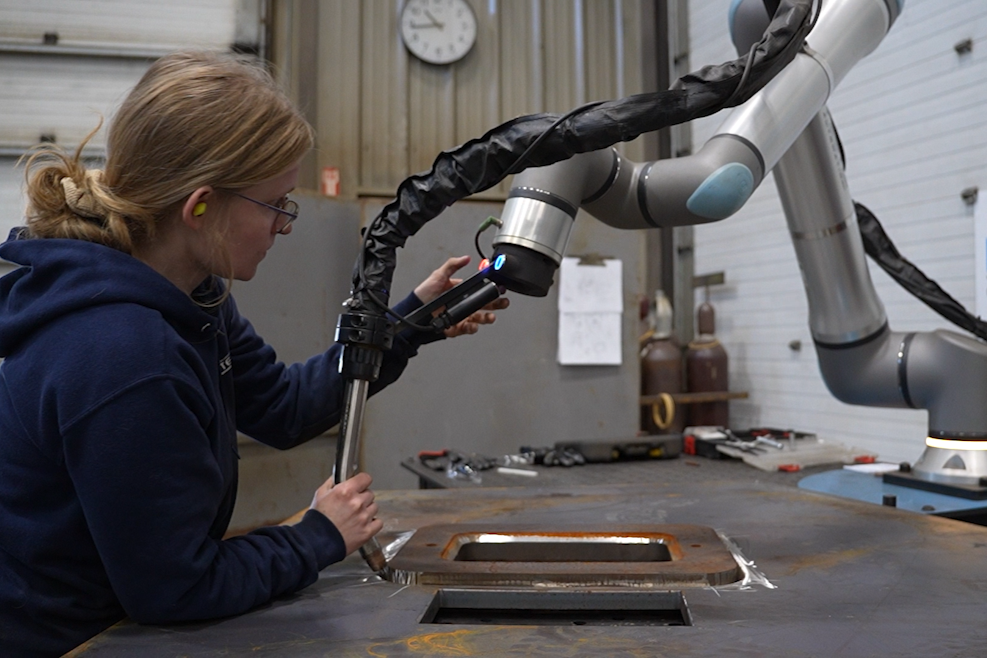
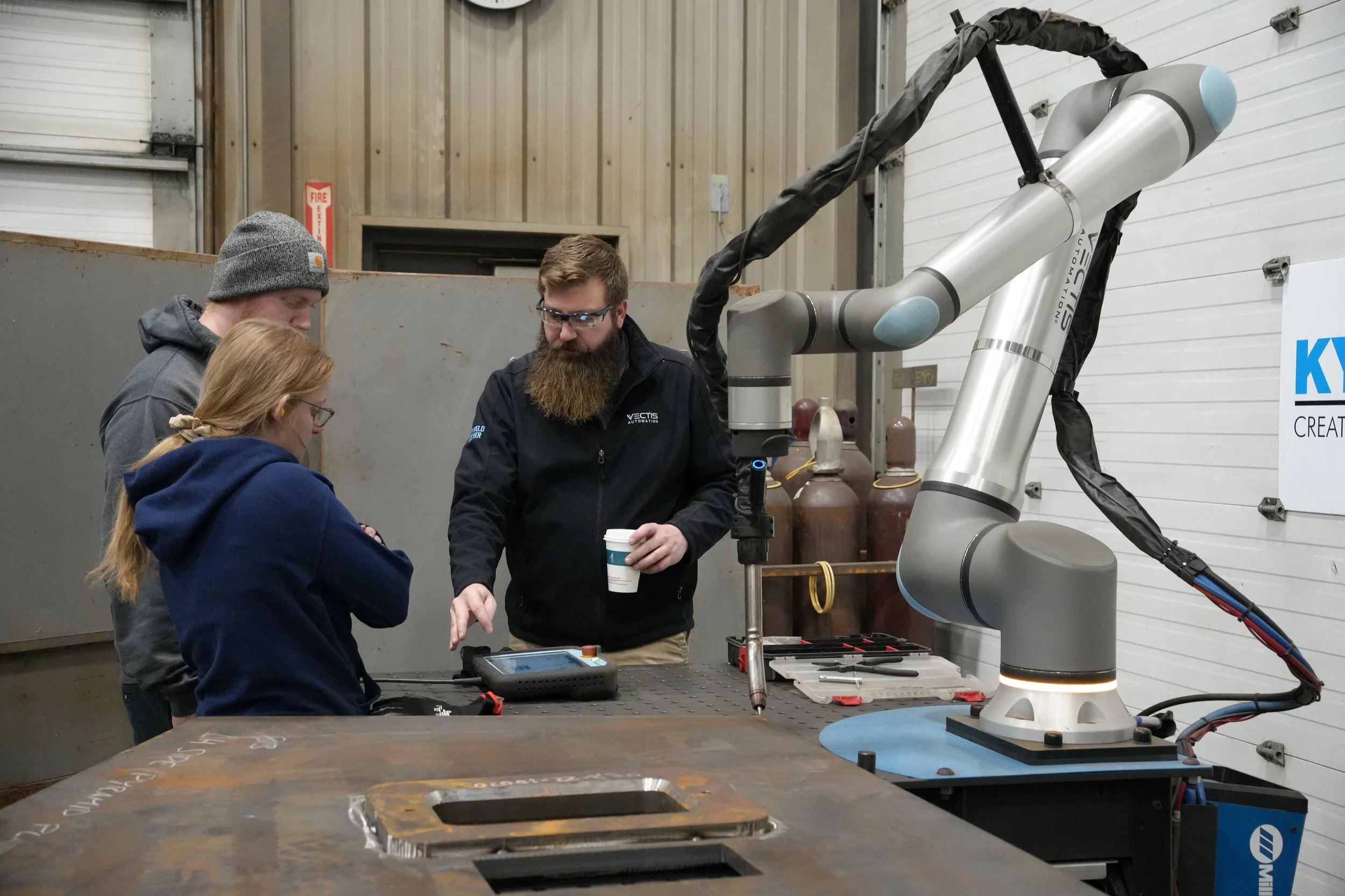
Introducing the cobot provided a practical way to extend the capabilities of their existing team, and presented an upskilling opportunity for workers such as Tyler Dimmell, a Senior Welder/Fabricator who has been with KYJO for nine years and enjoys the opportunity to expand his skillset into automation.
A skilled operator can set up the system and create a program, and then other team members — even those with limited welding experience — can operate it as needed. This flexibility is especially valuable for a small shop.
“We’re a small shop. So, if we have somebody away sick, it’s a bigger impact than in a shop with 100+ people working in it. Now, we can pull somebody from the rolling side, or ask for help pretty much anywhere, and they can just run the program to help us out,” explains Tyler.
With features like seam tracking, the system maintains consistent quality even when operated by less experienced team members, reducing reliance on a small pool of highly skilled welders for every task.
The importance of choosing the right integrator
Beyond the importance of choosing a system with robust programming capability, Kent and Luke remarked on the importance of working with a responsive and knowledgeable partner.
“If you go with a good, reputable company like Vectis, you pick up the phone, you send an email, and the people are there to help you in a timely manner.”
Luke emphasized this is especially crucial for their line of work, where project timelines are crucial and they can’t afford downtime.
“If we don’t keep moving ahead, we’re going to get left behind.”
After proving its value in daily production, the cobot has become a valuable and reliable tool in the toolbelt of KYJO’s operation.
The result is a stronger, more flexible operation that can respond to customer needs faster, reliably automate small runs of parts, take on larger opportunities, and continue delivering the quality their reputation is built on.
Luke stated that Vectis tools are, “something we would invest more in and look at buying another system, just because of the ease of when you need it, it’s there.” Kent echoed that they plan to add a 2nd and 3rd system in the future. “If we don’t keep moving ahead in the world with automation, we’re going to get left behind,” Kent concludes.