AWS Welding Journal: Will a Cobot Automation Solution Work for You?
This article was originally published in the July 2023 issue of AWS Welding Journal. Visit: https://www.aws.org/Magazines-and-Media/Welding-Journal/2023/July/
The collaborative robot (cobot) fabrication marketplace has changed rapidly in just a few short years. As an example, Vectis Automation, Loveland, Colo., was one of two cobot welding systems debuting at FABTECH 2019 in Chicago, Ill., compared to the dozens on display at FABTECH 2022 in Atlanta, Ga. There’s no shortage of hype and excitement around the possibilities that easy-to-use cobot automation brings to shop floors of all types and sizes. However, fabricators are now left to ponder these questions: “Is cobot welding/cutting really for me? And if so, how do I make the right choice?” These were the most common queries Vectis received at FABTECH 2022.
Shining a Spotlight on Cobot Automation
From customer interactions since the show, we often hear, “I get the idea of a cobot and I’ve seen them around — but will it robustly work in my shop, with my people, and on my applications?”
From what I hear and see in the marketplace, we’re moving past the open-to-risk early adopter phase and into the mainstream market phase, where individuals really take the time to do their due diligence on making a key decision. Oftentimes, they stake their job performance, reputation, and/or production plans on it. Even at the lower all-in cost of cobot automation relative to traditional caged robot cells, it’s still a not-insignificant expense for most shops.
For my colleague Doug Rhoda, founder and chair of Vectis and a robotic welding industry veteran of nearly four decades, there’s some déjà vu of the then-nascent traditional robotic industry at the start of his career.
“Amid all the new flash and marketing, there’s a lot of healthy skepticism by fabricators because so many have had or heard about a poor experience with automation in their past and are nervous to get burned again,” Rhoda said. “It reminds me a lot of the ‘Wild West’ of traditional robotic welding in the 1980s, when that industry was new and ‘scar-less.’ There was a lack of knowledge on both the buy-side and the sell-side, which led to some doomed installations and set the industry back years, if not decades. What’s interesting about those failures is that they weren’t always technology related; many times, it was just a poor application or poor knowledge/education/buy-in on what it takes to make automation successful. I’m hopeful the same doesn’t happen in the cobot welding industry. I think fabricators are asking the right questions now and collaborating with the right providers to make sure automation is going to be a fit for their applications and business overall.”
Support for Fabricators
A key piece of advice is that struggle is not always or solely because of the piece of technology itself. In our experience, the application and education have just as much, if not more, influence on success. For fabricators trying to decide if cobot welding is a fit and, if so, which provider to go with, I encourage them to ponder these four points.
1. Find your root production pain and target some potential applications to review with your integrator.
While your integrator will have cobot welding experience, no one knows your shop floor and pains like you do. Especially with affordable and accessible cobot automation, the justification and value-add can be derived from many routes: throughput increase, quality increase, welding skill-level augmentation, talent attraction and retention, reduction in overwelding, reduction in grinding, and oftentimes a combination of these. With the broad range of applications and justification paths, it’s critical for your provider to know what problems you’re looking to solve so they can make the best system/configuration recommendation for you.
A helpful mindset is to look for the low-hanging fruit: Let cobots tackle the mundane applications and enable the skilled labor to shift to those tasks requiring a higher skill level. Even on hundreds of job shop customers, whose only constant is variety, have a feel for what batches come up periodically and/or where they have quality or labor challenges where cobots can assist. There are manufacturers running cobot batch sizes of ones, twenties, fifties, one hundreds, and even ten thousands. The key to satisfactory justification in each of these cases is knowing what root production pains need to be solved and balancing tradeoffs on equipment and implementation decisions accordingly. This is ideally a collaborative discussion between the manufacturer and automation provider.
2. Does your potential provider have focused domain expertise on both cobots and welding?
What looks simple on a marketing video or brochure is not always easy to successfully implement on a shop floor. It’s important for your integrator to have expertise on both the cobot/programming/fixturing side and the welding side. Most challenges fabricators face with implementation are multifaceted and require a deep level of understanding for all aspects of welding automation. Make sure there are focused resources on that product line supporting your success as well.
3. What does the track record in cobot welding look like?
The provider’s performance in cobot welding, which is different than other automation and welding products, is what’s important here. Be sure to get the facts on your provider’s cobot install base, customer satisfaction rating, and especially repeat business. How many customers are spending dollars on a second, third, or tenth system? If you can, get a money-back guarantee on the system or some other risk-reducing assurance that it will perform as advertised for your team.
4. Listen to your gut.
At the end of the day, it’s all about trust. Do you trust your provider in both their character and competence? Even easy-to-use cobots are a piece of sophisticated technology under the hood that will need knowledgeable support at some time in their lifespan. Be sure to pick a provider you trust can competently be there when you need them to be. Our gut tends to be a pretty good indicator of trustworthiness, so don’t shy away from listening to it.
Final Thoughts
It’s an exciting time to be in this industry. With a renewed focus on American manufacturing and new technology like cobots helping boost productivity, it feels like we’re going through a manufacturing renaissance, one that will continue to attract much-needed talent and fuel new innovation in factories of all types and sizes. The key to keeping the momentum through this renaissance will be informed decisions on technology adoption, all in the name of avoiding struggles and quickly achieving reliable success on the shop floor.
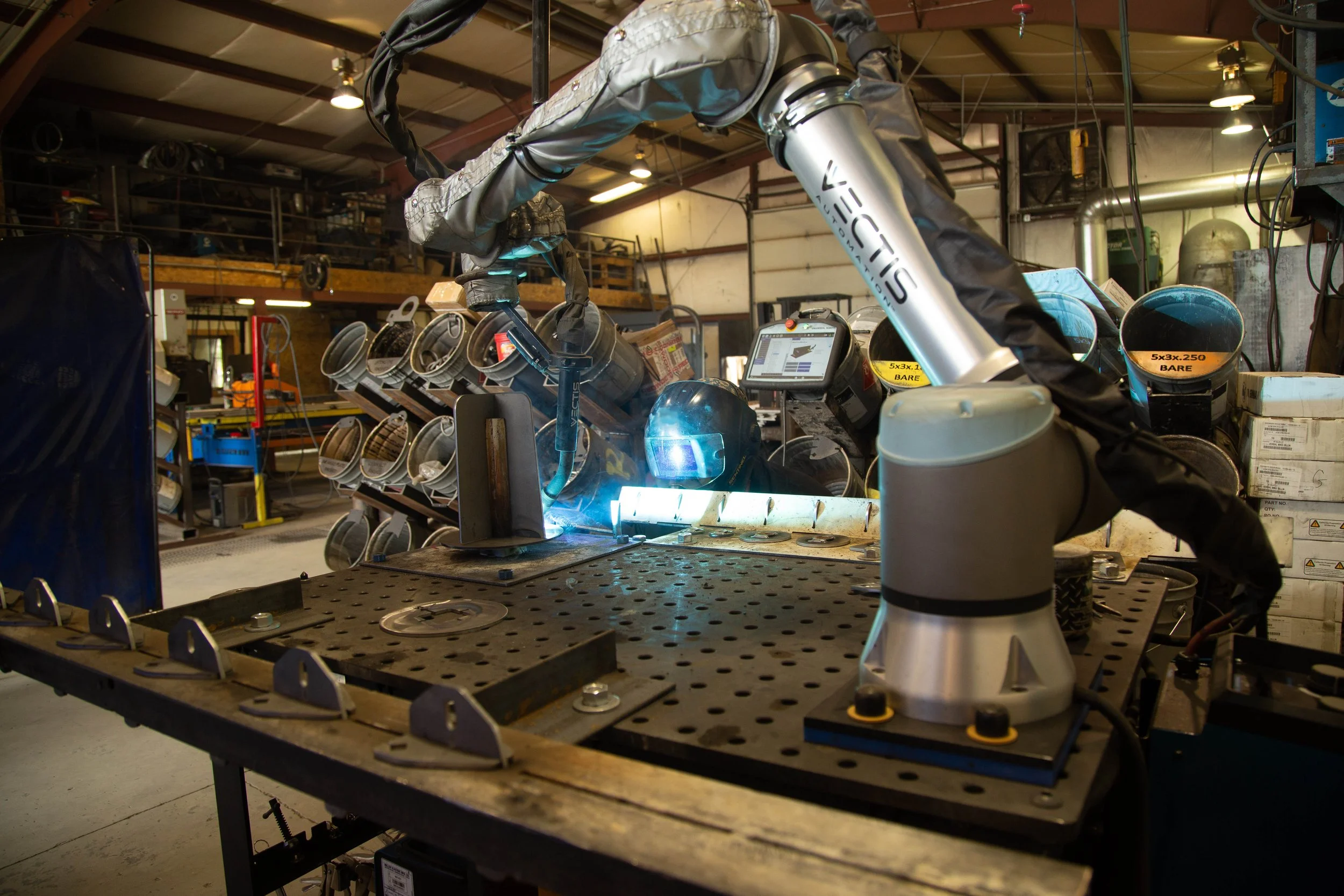
A solar mounting manufacturer welds kits of components with a Vectis tool, saving on changeover time and increasing productivity.

An automotive aftermarket manufacturer leverages a Vectis tool to triple throughput on bed racks. The weld quality achieved by the cobot has also allowed for the elimination of postweld grinding.